When the Waistcoat Left the Suit
When the waistcoat left the suit, its role shifted from required matching layer to independent choice, revealing how three-piece dress gradually changed.
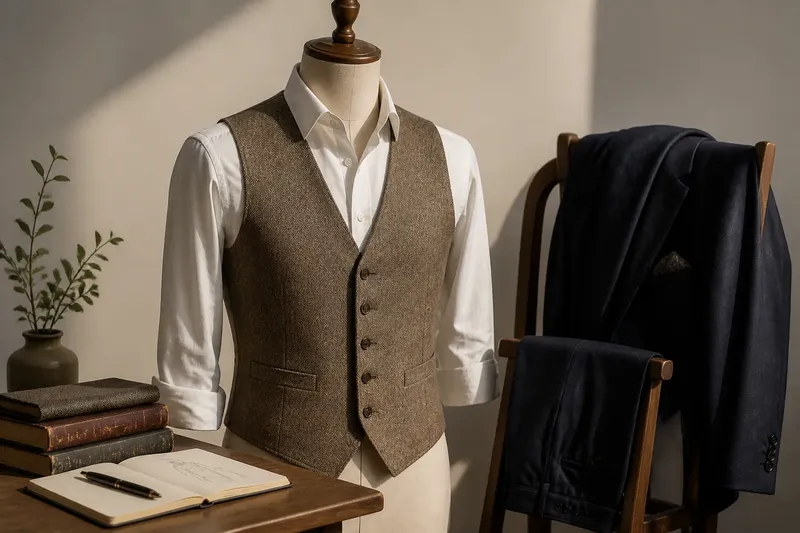
The waistcoat left the suit gradually: its place changed as the three-piece suit stopped being the default form of respectable everyday dress. In British clothing history, the shift was not a single moment when people abandoned the matching jacket. Rather, a waistcoat that had been one component of a coordinated outfit increasingly appeared as an optional, visible garment in its own right.
The three-piece suit made the waistcoat part of a set
A waistcoat is a sleeveless garment, usually fastened at the front, worn over a shirt. In a three-piece suit, it is coordinated with the jacket and trousers. It fills the space between shirt and jacket, so the wearer still has a finished-looking upper layer when the jacket is open or removed.
In Britain, the three-piece suit became a familiar form of men’s dress during the nineteenth century, when matching jacket, waistcoat and trousers were established as a standard tailored combination. Its conventions were clearest in formal and business settings, though the precise expectations varied by occupation, occasion and period. The waistcoat was not merely an extra layer: as part of a matched suit, it helped make the outfit read as a complete ensemble.
Clothing also had practical uses, but they depended on circumstances. An additional layer could provide warmth in an unheated room, while a waistcoat in a formal outfit could cover the shirt front and maintain a tailored appearance. Those functions overlapped; neither means that every wearer chose one for the same reason.
Two-piece suits made the waistcoat optional
The waistcoat’s separation from the suit is best understood through the growing acceptance of two-piece suits. A jacket and trousers could be worn as a complete coordinated suit without a waistcoat. As that arrangement became more familiar in business and everyday dress, the waistcoat ceased to be necessary for an outfit to count as a suit.
This was a gradual change, not a uniform national rule. Formal events and particular workplaces could retain three-piece dress, while other settings accepted two-piece suits or less formal combinations. The same garment might therefore look expected in one setting and optional in another.
Changes in work and social routines contributed to the shift, but they did not operate as one simple cause. As dress codes became less centred on a single suit formula, people could choose a jacket and trousers without a waistcoat, or wear a shirt without a jacket in settings where that was accepted. The waistcoat’s role narrowed from standard suit component to one option among several.
Wearing it alone changed what the garment could do
Once a matching jacket was no longer required, the waistcoat could serve as the main visible layer over a shirt. An unmatched waistcoat might be chosen deliberately, rather than treated as a missing piece of a suit. This did not make every waistcoat casual: a finely tailored one could still suggest formal dress, while its fabric, cut and companions shaped the overall impression.
Say an invented office situation begins with a dark matching three-piece suit worn for a formal meeting. Later, the office accepts two-piece suits and open-collar shirts for ordinary days. The wearer keeps the waistcoat, pairs it with a plain shirt and trousers that do not match it, and leaves off the jacket. The observable result is an outfit that retains a tailored element but no longer presents itself as a complete matching suit; the trade-off is that it may look more dressed-up than colleagues’ simpler combinations.
What does an independent waistcoat signal?
When did the waistcoat stop being essential to a suit?
There was no single date when it stopped being essential everywhere. The two-piece suit became an accepted complete form in many settings, while three-piece dress continued where custom or the occasion called for it.
Can a waistcoat without a matching jacket look formal?
Yes. A tailored cut and a neat shirt can preserve a formal impression, even when the waistcoat does not match the trousers. The event and its dress code still matter.
Does an unmatched waistcoat look unfinished?
Not automatically. It can look intentional when the colours and textures work together, but someone expecting a traditional matching suit may read it differently.
Why does the waistcoat still seem traditional?
Its close association with tailored suits and formal occasions remains visible in its shape and styling. Wearing it alone changes its role, but does not erase those associations.
The change was about the rules of the suit
The waistcoat did not simply become casual when it left the suit. Instead, the suit itself became less dependent on a three-piece arrangement. A waistcoat could retain formal associations while being worn without its matching jacket, and a two-piece suit could feel complete without one.
That distinction explains the garment’s continuing appeal to dressers who want a tailored element without the full matched set. The history of the waistcoat is therefore not just a story of fewer layers: it shows how a familiar piece can move from expected component to personal choice as the conventions around it change.
When considering a waistcoat today, the useful question is not only whether it matches a jacket, but what role it is meant to play. Matching pieces present a traditional suit; an independent waistcoat makes the layer itself the focus, while still carrying traces of the suit from which it came.